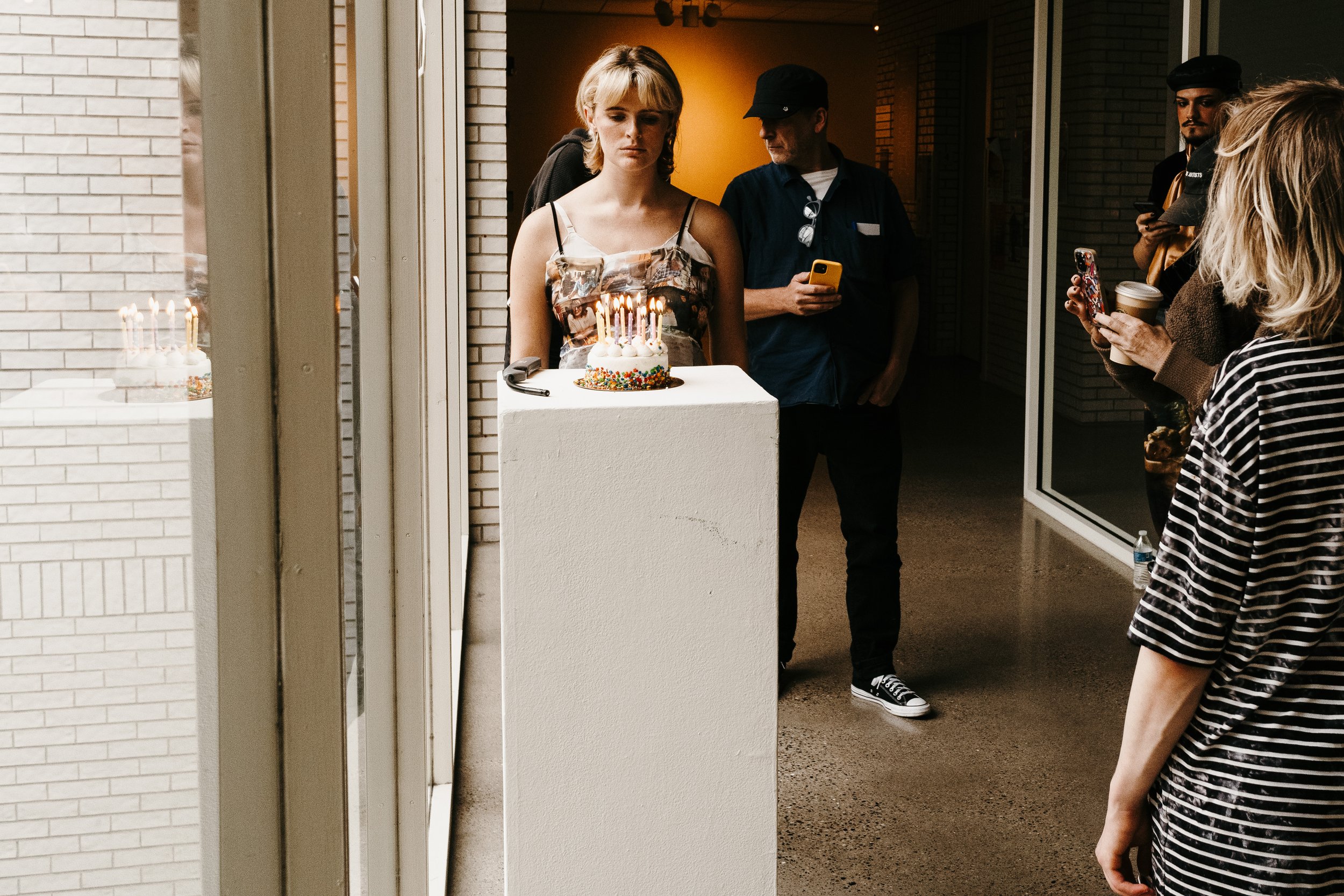
h0p3c0r3 is a wearable augmented reality installation that uses family photographs and a custom machine learning model to examine how grief, memory, and emotional attachment are mediated through mobile screens.
Augmented Reality, Spark AR, Custom GAN, Wearable Textile, 2023
‘h0p3c0r3’

This video documents an interpolation sequence generated by the custom machine learning model trained on my family photo archive. Rather than producing discrete images, the model is allowed to transition continuously between learned states, revealing how facial features, gestures, and spatial relationships dissolve and reassemble over time.
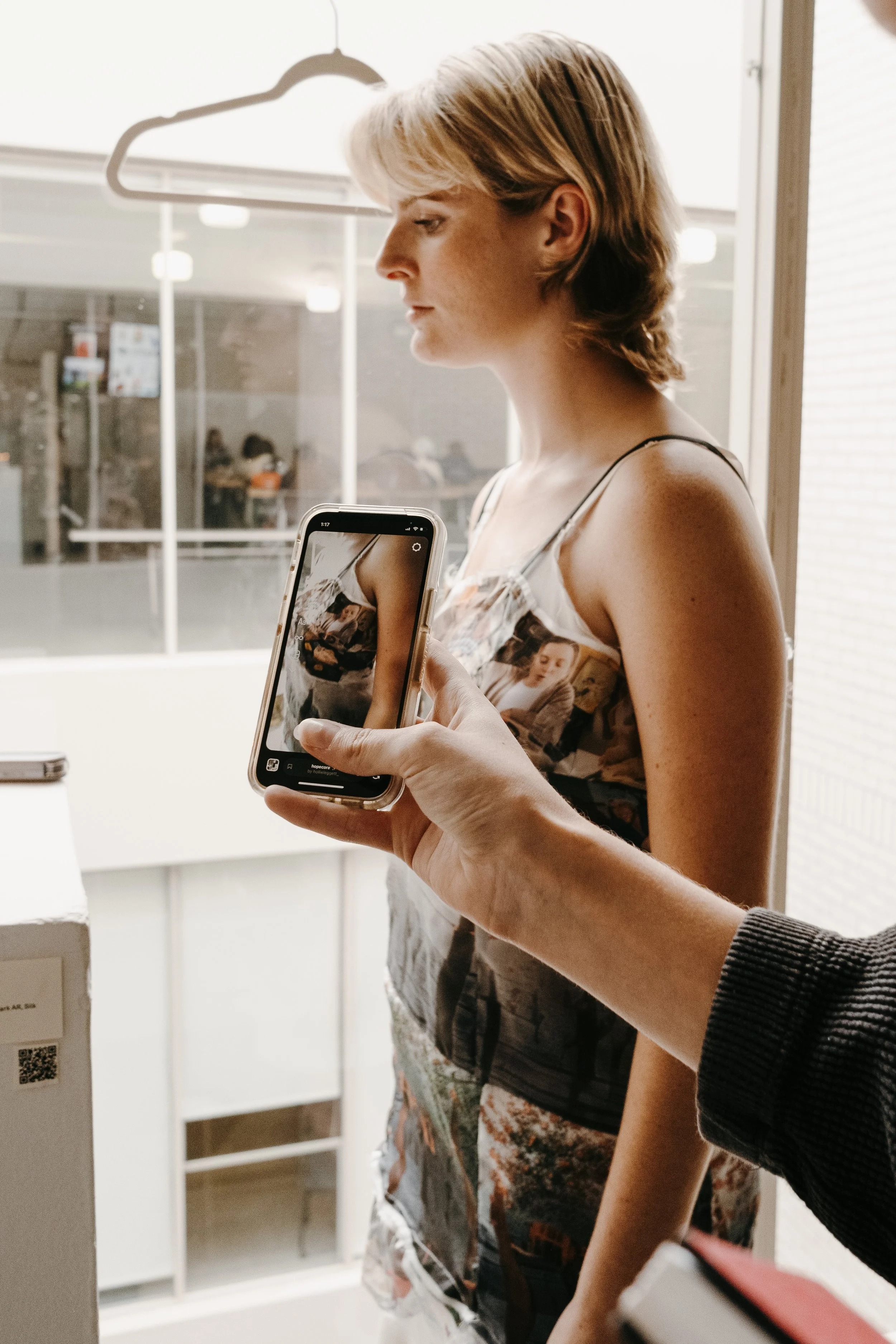



h0p3c0r3 centers on a dress sewn with thirty family photographs selected from a larger archive of over six hundred images. When viewed through a mobile phone, specific images on the garment activate an augmented reality layer that reveals new visuals generated by a machine learning model trained on that family archive.
These generated images appear only on the phone screen, positioning the device as both mediator and gatekeeper of memory. The mobile phone, often treated as a disposable interface, becomes a fragile and necessary object in the experience. Viewers must slow down, hold the device carefully, and engage with it intentionally. At the same time, these devices encourage constant accumulation, circulation, and consumption of images.
Experience & Intent
This project emerged from my interest in how emotional experience is shaped by technological systems, particularly in moments of loss.
h0p3c0r3 questions whether the abundance of personal imagery strengthens memory or erodes it. By training a machine learning model on a dense family archive, I intentionally introduced a system that does not preserve images faithfully. The generated outputs blur faces, collapse gestures, and erase recognizable features. Rather than producing clearer memories, the model reveals how excess information can flatten and destabilize meaning.
The project treats technological distortion as a signal rather than a failure. The loss of legibility mirrors the way memories shift over time, especially when mediated through screens that privilege quantity over care.
Process and Dataset Decisions
The training dataset consists of approximately 600 family photographs spanning multiple generations and recurring rituals such as birthdays and gatherings.
Only thirty images appear physically on the garment, emphasizing selection and limitation over completeness.
The machine learning model was intentionally constrained, producing images that resist realism and familiarity.
The augmented reality layer is accessible only through a mobile phone, reinforcing the phone’s role as an intimate but unstable archive.
These choices were made to foreground questions of control, authorship, and emotional responsibility when working with personal data. The system was designed not to preserve memory accurately, but to reveal how computational systems reshape emotional material through accumulation and abstraction.
Context and Influences
This project is informed by works that critically engage with technological absence and illegibility. Kat Mustatea’s Voidopolis, which removes human presence from images and renders language unreadable through algorithmic constraint, was particularly influential in shaping how I think about loss and system behavior. The cyclical erasure and renewal in that work parallels my interest in memory as something that dissolves and reforms rather than remains fixed.
Connection Forward
h0p3c0r3 was an early exploration of how data saturation and computational mediation affect meaning. The questions that surfaced here continue into my current work with environmental sensing and spatial data, where distortion, omission, and access reveal the values embedded in technical systems. This project marked a shift in how I approach technology, not as a tool for preservation alone, but as a structure that actively shapes what is remembered and who that memory serves.
h0p3c0r3 is a wearable system where physical images and computational processes coexist without resolution. The performance documents the act of activating memory through the body and the phone, making visible how emotional experience is filtered, delayed, and reshaped by technical mediation.